From Flight School to the Cockpit: A Guide to Pilot Careers
Introduction
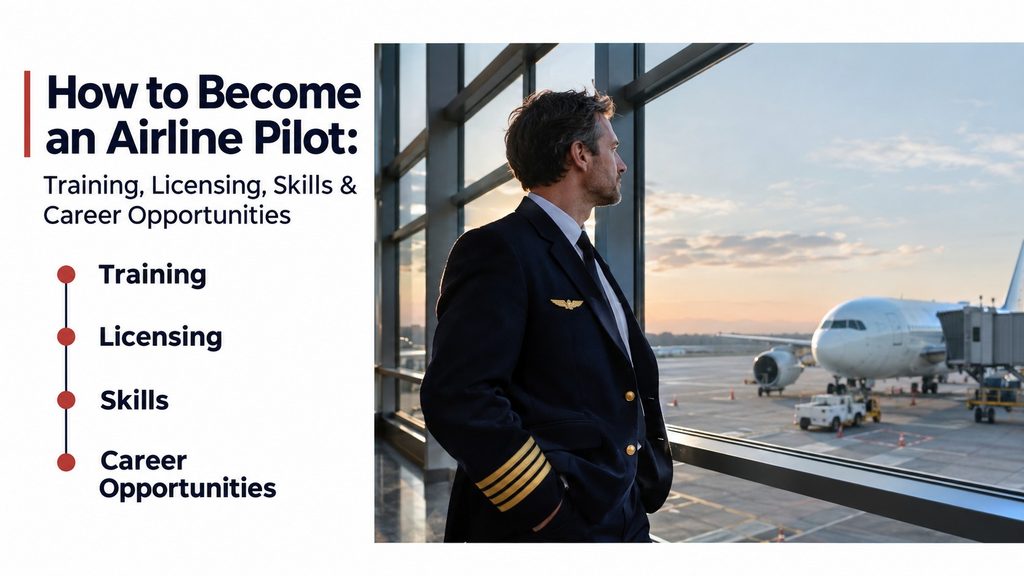
Flying an aircraft requires skill, knowledge, and sound judgment. Airline pilots carry a major responsibility because they help protect passengers, crew, and aircraft. Their work also involves planning, communication, weather checks, and teamwork.
Many people dream of entering this profession. Yet the path can seem confusing at first. Different licences, medical checks, flight hours, and training choices all matter.
This guide breaks the journey into clear stages. You will learn about pilot qualifications, flight schools, astronaut careers, and simulator tools. It also explains how aviation and space careers differ. Use these details to make informed choices before you begin training.
1. How to Become an Airline Pilot
If you want to fly for an airline, start by understanding the full qualification process. Each country has its own aviation regulator. That regulator sets the rules for pilot licences, medical fitness, training, and examinations.
Here is a simple way to plan your journey.
Step 1: Understand the career
Research what airline pilots do each day. Their duties include checking flight plans, reviewing weather, inspecting aircraft documents, communicating with air traffic control, and following safety procedures.
Step 2: Review education requirements
Check the academic requirements for your chosen training route. Mathematics, physics, and English can help you understand technical subjects and communicate clearly.
Step 3: Check medical eligibility
Aviation authorities require pilots to meet specific medical standards. Find out which medical examination applies to your intended licence.
Step 4: Compare flight schools
Look at approved schools and their training programmes. Compare aircraft, instructors, facilities, schedules, and complete costs.
Step 5: Begin practical training
Learn aircraft controls, navigation, radio procedures, and safe flying practices. Your instructor will guide your progress.
Step 6: Earn the required qualifications
Continue through the licence stages and ratings needed for your career goal. The exact pathway depends on the regulator and employer.
Step 7: Prepare for airline recruitment
Build your technical knowledge, communication skills, and professional confidence. Research the selection process used by airlines that interest you.
A good plan starts with official information. Do not assume that a qualification from one country automatically meets another country’s requirements.
2. Private Pilot License Requirements
A private pilot licence is often the first major qualification in a pilot’s journey. It gives students a foundation in aircraft operations and flight safety.
The private pilot license requirements depend on the country, aircraft category, and licence type.
In a typical training programme, students study:
- Basic aerodynamics.
- Aircraft controls and instruments.
- Aviation weather.
- Flight planning and navigation.
- Radio communication.
- Airspace rules.
- Aircraft performance.
- Normal and emergency procedures.
Students also complete practical flight training. They learn how to prepare an aircraft, perform manoeuvres, manage a flight, and respond to changing conditions.
A private licence generally supports flying within defined private privileges. It does not automatically allow someone to work as an airline pilot.
Before enrolling, ask the flight school to explain its training syllabus. Find out how it records flight progress and prepares students for examinations.
3. Commercial Pilot License Requirements
A commercial pilot licence is a key qualification for people who want to work as professional pilots. It provides privileges that go beyond ordinary private flying.
However, the commercial pilot license requirements are not identical across countries.
A commercial training route may include:
- Advanced aviation theory.
- Aircraft performance and limitations.
- Navigation and flight planning.
- Practical flight exercises.
- Required flight experience.
- Medical certification.
- Written or knowledge examinations.
- A practical skills test.
The training helps pilots improve accuracy and decision-making. They learn to manage more complex flight tasks and follow professional operating procedures.
Some jobs may also require extra qualifications. These can include instrument or multi-engine ratings, depending on the aircraft and operation.
Check the rules before choosing a course. Ask whether the advertised package includes the required examinations, aircraft time, instructor fees, and other charges.
A commercial licence is an important step. It does not guarantee employment with an airline.
4. Pilot Training Programs in the USA
The United States has different routes for people who want to learn to fly. Students can consider independent flight schools, university aviation programmes, and other approved training organisations.
When comparing pilot training programs in the USA, review the complete training experience.
Check the school’s approval
Confirm which training programmes the school can offer. Understand the difference between the training route and the licence you want to earn.
Review the aircraft
Ask which aircraft students use. Find out how many aircraft are available and how the school handles maintenance or scheduling delays.
Understand the instructor system
Good instruction matters. Ask about instructor qualifications, lesson planning, student support, and progress reviews.
Compare the full price
Do not compare schools using tuition alone. Check aircraft rental, instructor time, examinations, medical checks, equipment, and other possible charges.
Examine the training schedule
Some students prefer an intensive programme. Others need a flexible schedule. Choose a route that fits your time and finances.
Ask about career preparation
Find out whether the school offers interview practice, career guidance, or support with further qualifications.
International students should also check visa rules and other legal requirements before enrolling.
A useful approach is to contact several schools and request written information. Compare their answers before making a decision.
5. Airline Transport Pilot License Requirements
The Airline Transport Pilot qualification is an advanced pilot certification. It supports professional operations that require a high level of experience and responsibility.
The airline transport pilot license requirements depend on the aviation authority and the type of aircraft involved.
Regulators may set requirements for:
- Minimum age.
- Medical certification.
- Total flight experience.
- Pilot-in-command experience.
- Cross-country experience.
- Instrument flying experience.
- Night flying experience.
- Knowledge examinations.
- Practical skills testing.
For example, the FAA has specific ATP certification pathways. Some routes include different experience conditions. Other countries use their own licensing systems.
Do not use a general online checklist as your final authority. Review the current regulations for your country and intended licence.
It is also important to understand the difference between holding an advanced licence and meeting an airline’s recruitment standards. An employer may set additional experience, training, and assessment requirements.
6. How to Become an Astronaut
Astronauts help carry out human spaceflight missions. Their work may involve research, spacecraft operations, engineering, experiments, and mission support.
People asking how to become an astronaut should first explore the professional backgrounds that space agencies value.
Possible study and career areas include:
- Aerospace engineering.
- Mechanical engineering.
- Electrical engineering.
- Computer science.
- Physics.
- Mathematics.
- Medicine.
- Biological science.
A strong academic record can help, but education alone may not be enough. Astronaut candidates often bring years of professional experience.
Selection processes can include technical assessments, medical checks, interviews, teamwork exercises, and demanding training activities.
Different space agencies use different selection rules. Some recruit pilots, while others consider scientists, engineers, and medical professionals.
You can begin by choosing a technical or scientific field that interests you. Build practical skills through projects, research, and professional work.
Remember that astronaut selection is highly competitive. A useful long-term goal is to develop expertise that also supports a rewarding career outside spaceflight.
7. Astronaut Training for Students
Students can explore astronaut-related subjects through schoolwork and practical activities. They do not need to wait until university to develop useful skills.
Good astronaut training for students starts with curiosity and a strong foundation in science.
Explore physics
Learn about gravity, motion, force, energy, and momentum. These subjects explain many ideas behind rockets and spacecraft.
Study mathematics
Mathematics supports measurement, calculations, navigation, and engineering. Practice solving problems rather than memorising answers.
Learn coding
Begin with a programming language such as Python. Try simple projects involving calculations, charts, or sensor data.
Join science activities
Take part in science fairs, robotics clubs, astronomy groups, or engineering challenges. These activities help students learn through practical work.
Build communication skills
Practice explaining a project to classmates. Clear communication matters when people work together on complex missions.
Learn about space missions
Read about spacecraft, satellites, space stations, and planetary exploration. Use educational resources from recognised space agencies.
Students should choose activities that match their age and available resources. Safety should always come first, especially when working with electronics, tools, or model rockets.
8. Pilot Training vs Astronaut Training
Both pilots and astronauts work in demanding technical environments. They need discipline, communication, teamwork, and the ability to make careful decisions.
However, their training prepares them for different tasks.
| Comparison | Pilot Training | Astronaut Training |
|---|---|---|
| Main purpose | Safe aircraft operation | Human spaceflight and mission work |
| Main subjects | Aviation, navigation, weather | Space science, engineering, mission systems |
| Practical training | Aircraft handling and procedures | Spacecraft operations and mission simulations |
| Work setting | Airports and aircraft | Spacecraft, laboratories, and mission centres |
| Career options | Airlines, charter, instruction | Space agencies, research, and engineering |
| Key focus | Flight safety and aircraft operations | Mission safety and space exploration |
The choice between pilot training vs astronaut training depends on what you want to do.
A person who enjoys aircraft and aviation operations may prefer pilot training. Someone interested in science, spacecraft, and research may prefer an astronaut-related career path.
There is some overlap. Both careers value situational awareness, teamwork, technical understanding, and calm decision-making.
You can also study a field that connects both areas. Aerospace engineering, for example, supports aircraft and spacecraft development.
9. Spaceflight Basics for Beginners
Spaceflight involves many scientific ideas. Beginners can start with a few simple concepts before studying advanced spacecraft systems.
These spaceflight basics for beginners provide a useful starting point.
Gravity
Gravity is the attraction between objects with mass. It plays a major role in the movement of planets, moons, satellites, and spacecraft.
Thrust
Thrust is a force that moves a vehicle forward or changes its motion. Rocket engines produce thrust by expelling material in the opposite direction.
Orbit
An orbit is the path an object follows around another body. Satellites and spacecraft can remain in orbit when their speed and gravitational motion create a suitable path.
Launch
A rocket carries a spacecraft away from Earth. The launch process must follow a planned path and account for forces, fuel, and changing conditions.
Microgravity
People in orbit often appear weightless. This happens because the spacecraft and its occupants are in continuous free fall around Earth.
Spacecraft systems
A crewed spacecraft needs several systems. These may support electrical power, communication, navigation, temperature control, and life support.
Beginners can study these subjects through science books, educational videos, astronomy activities, and official space agency materials.
Understanding these ideas makes more advanced topics easier to follow.
10. Best Flight Simulator Software for Student Pilots
Flight simulator software gives students a virtual place to explore aircraft and aviation procedures. It can support learning before or alongside formal training.
The best flight simulator software for student pilots depends on the student’s goals, computer, budget, and instructor recommendations.
Here are three platforms worth exploring.
Microsoft Flight Simulator
Features:
- Detailed virtual landscapes.
- Different aircraft models.
- Airport and route exploration.
- Weather and environmental settings.
- Support for compatible flight controls.
Pros:
- Engaging visual experience.
- Useful for exploring routes and airports.
- Offers a range of aircraft.
Cons:
- May require a powerful computer.
- Some advanced training features may depend on aircraft add-ons.
- Hardware and add-ons can raise the total cost.
Practical workflow:
- Choose a basic aircraft.
- Learn the cockpit layout.
- Explore airport environments.
- Practice simple navigation concepts.
- Review your learning with suitable training material.
X-Plane
Features:
- Aircraft flight simulation.
- Different aircraft and environments.
- Support for compatible control hardware.
- Options for add-ons and configuration.
Pros:
- Useful for exploring aircraft handling.
- Supports different simulation setups.
- Offers learning opportunities for aviation enthusiasts.
Cons:
- New users may need time to learn its controls.
- Some features may require additional purchases.
- It cannot replace real aircraft instruction.
Practical workflow:
- Select a suitable aircraft.
- Review its instruments and controls.
- Explore basic flight procedures.
- Practice navigation concepts.
- Compare your learning with instructor guidance.
Prepar3D
Features:
- Simulation platform with training-focused uses.
- Configurable scenarios.
- Support for different aircraft and environments.
- Options for specialised setups.
Pros:
- Can support structured simulation activities.
- Offers configuration flexibility.
- May suit some institutional training environments.
Cons:
- Setup can require technical knowledge.
- Licensing needs careful review.
- Suitability depends on the user’s training goals.
Practical workflow:
- Review current licensing options.
- Check computer compatibility.
- Choose an appropriate aircraft or scenario.
- Explore normal operating procedures.
- Review the experience with qualified guidance.
A note for students: A desktop simulator does not provide a pilot licence or replace approved flight hours. Treat it as a supplementary learning tool.
A Beginner’s Checklist Before Joining Flight School
Use this checklist when you start comparing training options.
- Decide which country you want to train in.
- Identify the aviation authority responsible for licensing.
- Research the medical requirements.
- Compare approved flight schools.
- Request a full cost breakdown.
- Review aircraft and instructor availability.
- Understand the licence stages.
- Ask about examination and test fees.
- Check international licence conversion rules if relevant.
- Read the school’s terms before making payment.
Keep copies of written information from each school. This makes it easier to compare options fairly.
Skills That Help Build a Strong Aviation Career
Technical knowledge is only one part of professional flying. Pilots also need personal and workplace skills.
Communication: Pilots exchange information with air traffic controllers, crew members, and ground teams.
Decision-making: They must assess changing conditions and follow safe procedures.
Situational awareness: They need to understand what is happening around the aircraft.
Teamwork: Airline operations depend on cooperation between many professionals.
Time management: Pilots work with schedules, flight plans, and operational deadlines.
Continuous learning: Aviation rules, aircraft systems, and operating procedures can change. Pilots must keep their knowledge current.
You can develop many of these skills through study, group projects, practical training, and work experience.
Explore Aviation and Space with AstroPilot
Aviation and space education cover many connected subjects. Readers may want to understand pilot licences, aircraft systems, astronaut careers, or the science behind space missions.
AstroPilot – Astronaut & Pilot publishes educational content about aviation careers, flight training, flight simulators, astronaut preparation, and space exploration.
You can use the publication to explore new topics and build your general knowledge. For professional licensing decisions, always confirm requirements through the relevant aviation authority and approved training provider.
Frequently Asked Questions
1. What is the first step toward an airline pilot career?
Start by researching the licence pathway in your country. Check education and medical requirements. Then compare approved flight schools, training costs, and course structures before choosing a programme.
2. Can a private pilot become an airline pilot?
Yes. A private pilot can continue training toward professional qualifications. The next stages depend on the country’s licensing system and may include commercial training, additional ratings, and further flight experience.
3. Is a commercial pilot licence enough to fly an airline aircraft?
Not necessarily. Airline roles can require additional qualifications, experience, ratings, and employer assessments. Candidates must meet the rules of the relevant aviation authority and the airline’s recruitment standards.
4. How can I compare flight schools in the USA?
Review each school’s approval, aircraft fleet, instructors, training schedule, facilities, and total costs. Ask for a written fee breakdown and confirm that the programme matches your intended licence pathway.
5. Why is an ATP qualification important?
An ATP qualification represents an advanced level of pilot certification. It has specific experience and testing requirements. The exact privileges and conditions depend on the regulator and aircraft category.
6. Do astronauts need engineering degrees?
Not every astronaut follows the same educational path. Engineering is one possible route, but science, medicine, mathematics, and other specialist backgrounds may also support astronaut applications.
7. Can school students prepare for an astronaut career?
Yes. Students can study mathematics, physics, coding, and astronomy. Science clubs, robotics projects, and teamwork activities can also help them build useful knowledge and practical skills.
8. What skills do pilots and astronauts share?
Both careers value communication, teamwork, technical understanding, situational awareness, and sound decision-making. Their training differs, but these skills support safe work in complex environments.
9. Can flight simulator software teach real flying?
Simulators can help learners understand aircraft controls, navigation, and cockpit procedures. However, they cannot replace approved flight instruction, real aircraft experience, or official licensing tests.
10. Where can I learn more about aviation and space?
You can explore aviation authority resources, flight school publications, educational books, and space agency websites. AstroPilot also provides articles about pilot careers, flight training, astronaut topics, and space exploration.
Conclusion
Aviation and space exploration offer different ways to build a technical career. Pilot training focuses on aircraft operations and flight safety. Astronaut-related careers involve science, engineering, research, and mission preparation.
Before choosing a path, understand its qualifications and costs. Check official rules and compare training options carefully. Build your knowledge through regular study and practical activities.
You do not need to make every decision at once. Start with one clear goal, research it well, and take the next practical step. A thoughtful plan can help you move toward a career in aviation or space.
Explore more: https://www.astropilot.co/
Leave a Reply