Quantum Computing Training and Practical Skills for Modern Professionals
1. Introduction
Quantum computing is developing a new approach to processing information. It uses quantum principles to perform computational operations differently from traditional computers. This technology has created interesting learning opportunities for software developers, cloud engineers, researchers, system architects, and IT managers.
However, becoming familiar with quantum computing requires more than understanding basic definitions. Professionals need mathematical knowledge, programming skills, circuit development experience, and an understanding of computing infrastructure.
A structured training programme can help learners develop these skills gradually. It should connect theory with practical experiments and technical assessments. Learners should understand how quantum circuits work, how cloud platforms support execution, and why physical quantum devices have limitations.
This guide explains ten important quantum computing topics in detail. It covers essential concepts, training requirements, step-by-step learning processes, practical assignments, and professional applications.
2. Build Your Technical Foundation Before Starting
A strong foundation makes quantum computing easier to understand. Prepare your mathematics, programming, and computing knowledge before moving into advanced topics.
2.1 Mathematics Fundamentals
Study these mathematical subjects:
- Algebra: Understand equations, variables, and mathematical operations.
- Vectors: Learn vector representation and basic calculations.
- Matrices: Study matrix addition, multiplication, and transformations.
- Probability: Understand possible outcomes and probability distributions.
- Complex Numbers: Learn real and imaginary components.
- Linear Algebra: Understand how mathematical transformations represent quantum operations.
2.2 Programming Fundamentals
Python is a useful starting language for quantum development.
Learn these concepts:
- Variables and data types.
- Conditional statements.
- Loops and functions.
- Lists and dictionaries.
- Classes and objects.
- Modules and packages.
- Error handling.
- Virtual environments.
- Debugging.
- Git and version control.
2.3 Quantum Fundamentals
Understand these important principles:
- Qubits and quantum states.
- Superposition and entanglement.
- Quantum gates and circuits.
- Measurement and probability.
- Quantum interference.
- Quantum algorithms.
- Quantum noise.
- Error correction.
These subjects prepare you for programming, cloud execution, and system architecture.
3. Ten Important Quantum Computing Keywords Explained in Detail
3.1 quantum cloud computing training
3.1.1 What Is Quantum Cloud Computing Training?
Quantum cloud computing training teaches professionals how to access and use quantum computing resources through remote cloud environments.
It combines quantum programming knowledge with cloud infrastructure skills. Learners discover how to prepare circuits, configure access, select computing resources, submit jobs, monitor execution, and analyse results.
Cloud environments make experimentation more accessible. Learners can use supported simulators and remote quantum hardware without purchasing specialised equipment.
3.1.2 Important Skills Covered
A detailed training programme should cover:
- Cloud computing fundamentals.
- Quantum computing principles.
- Python programming.
- Quantum programming frameworks.
- Circuit development.
- Simulator configuration.
- Cloud authentication.
- Identity and access permissions.
- Remote task submission.
- Execution monitoring.
- Measurement result collection.
- Resource management.
- Cost evaluation.
- Hybrid computing workflows.
3.1.3 Step-by-Step Learning Process
Step 1: Learn cloud infrastructure.
Understand cloud accounts, regions, computing resources, storage, and access permissions.
Step 2: Study quantum fundamentals.
Understand qubits, superposition, entanglement, quantum gates, and measurement.
Step 3: Prepare a development environment.
Install Python and create a separate project environment.
Step 4: Select a programming framework.
Learn how the framework represents circuits and quantum operations.
Step 5: Create a basic circuit.
Start with one or two qubits. Apply simple gates and add measurements.
Step 6: Run a local simulation.
Test the circuit with an appropriate simulator before attempting remote execution.
Step 7: Understand authentication.
Learn how approved credentials and permissions provide access to cloud resources.
Step 8: Select an execution resource.
Review available simulators and supported quantum devices.
Step 9: Submit a quantum task.
Send the circuit to the selected execution environment.
Step 10: Monitor execution.
Check the task status and understand possible execution errors.
Step 11: Retrieve measurement results.
Collect the output and save the experiment configuration.
Step 12: Evaluate the results.
Compare the remote output with your simulation and explain any differences.
3.1.4 Practical Training Assignment
Build a two-qubit Bell-state circuit. First, test it with an ideal simulator. Then run a supported cloud experiment.
Prepare a report containing:
- Circuit design.
- Number of qubits.
- Gate operations.
- Execution environment.
- Measurement settings.
- Result distribution.
- Execution limitations.
3.1.5 Professional Applications
This training can support cloud engineers, DevOps professionals, software developers, quantum application developers, and research teams.
3.1.6 Expected Learning Outcome
You should understand how to prepare quantum workloads, submit remote tasks, monitor execution, retrieve measurements, and evaluate cloud execution limitations.
3.2 quantum computing certification course
3.2.1 What Is a Quantum Computing Certification Course?
A quantum computing certification course provides structured education in quantum mathematics, programming, algorithms, circuits, and practical experimentation.
It helps learners follow a planned curriculum instead of studying disconnected topics. Some courses target beginners, while others focus on software developers, researchers, architects, and technology managers.
A quality training programme should combine theoretical lessons with practical assignments and meaningful assessments.
3.2.2 Important Course Modules
A comprehensive curriculum may include:
- Classical computing fundamentals.
- Introduction to quantum computing.
- Mathematics and linear algebra.
- Qubits and quantum states.
- Superposition and entanglement.
- Quantum gates and circuits.
- Measurement and probability.
- Quantum programming frameworks.
- Quantum algorithms.
- Simulator execution.
- Quantum hardware concepts.
- Cloud computing workflows.
- Hybrid quantum-classical computing.
- Error correction fundamentals.
- Practical projects and assessments.
3.2.3 Step-by-Step Course Selection
Step 1: Identify your career objective.
Choose whether you want programming, cloud engineering, architecture, research, or management skills.
Step 2: Evaluate your current knowledge.
Review your mathematics, Python, and computing fundamentals.
Step 3: Examine the course syllabus.
Check whether its modules match your learning requirements.
Step 4: Review practical training.
Look for circuit development, simulations, coding exercises, and assignments.
Step 5: Evaluate instructor experience.
Understand the trainer’s technical knowledge and teaching background.
Step 6: Review assessment methods.
Check examinations, programming tasks, practical exercises, and final projects.
Step 7: Understand the duration.
Make sure the schedule provides sufficient time for practice.
Step 8: Verify the certificate issuer.
Understand which organisation awards the certificate.
Step 9: Check recognition claims.
Verify independent accreditation or professional recognition separately.
Step 10: Evaluate overall learning value.
Compare curriculum quality, practical depth, training support, and assessment requirements.
3.2.4 Practical Assessment Example
A final assessment may require you to create a two-qubit circuit, explain its gates, execute a simulation, analyse the measurements, and discuss its limitations.
3.2.5 Professional Applications
A structured course can support students, developers, cloud professionals, researchers, and managers seeking professional development.
3.2.6 Expected Learning Outcome
You should understand the major areas of quantum computing and demonstrate your knowledge through practical tasks. A course completion certificate does not automatically represent an accredited qualification or guarantee employment.
3.3 QuantumOps certification
3.3.1 What Is QuantumOps Certification?
QuantumOps certification is a professional development topic connecting quantum computing with engineering, operations, architecture, cloud infrastructure, and management.
It focuses on understanding how quantum workloads move through development, testing, simulation, execution, monitoring, and technical evaluation.
The learning approach helps professionals understand the operational requirements behind quantum computing projects.
3.3.2 Important Learning Areas
A structured programme may cover:
- Quantum computing fundamentals.
- Quantum programming.
- Circuit development and testing.
- Algorithm fundamentals.
- Hardware awareness.
- Quantum architecture.
- Cloud infrastructure.
- Remote job management.
- Hybrid computing.
- Error correction concepts.
- Technical troubleshooting.
- Project planning.
- Operational evaluation.
- Technical documentation.
3.3.3 Understand the Professional Learning Tracks
A. Quantum Engineer Track
Focuses on programming, circuit development, simulator execution, testing, and debugging.
B. Quantum Architect Track
Focuses on system design, application requirements, compilers, hardware mapping, and technical integration.
C. Quantum Manager Track
Focuses on budgets, training requirements, resource management, project planning, and technology evaluation.
D. Quantum Professional Track
Develops broader knowledge of quantum computing concepts, tools, applications, and professional responsibilities.
3.3.4 Step-by-Step Learning Process
- Identify your professional role.
- Review your current technical skills.
- Define your learning objectives.
- Study quantum computing fundamentals.
- Learn programming frameworks.
- Practise circuit development.
- Explore simulator environments.
- Understand cloud execution.
- Study architecture and operations.
- Complete a practical project.
- Prepare technical documentation.
- Review the assessment requirements.
- Verify the certificate issuer.
3.3.5 How to Evaluate a QuantumOps Programme
Check the syllabus, practical exercises, instructor background, assessment method, certificate details, and any independent recognition claims.
The term QuantumOps certification does not automatically establish independent accreditation. Verify the specific programme before enrolling.
3.3.6 Practical Assignment
Prepare a small quantum computing project that includes circuit creation, simulator testing, execution analysis, and operational documentation.
3.3.7 Professional Applications
This subject can support engineers, software developers, cloud specialists, system architects, operations professionals, and technology managers.
3.3.8 Expected Learning Outcome
You should understand how quantum engineering, cloud operations, system architecture, and management contribute to professional projects.
3.4 Qiskit programming course
3.4.1 What Is a Qiskit Programming Course?
A Qiskit programming course teaches learners how to create, execute, and analyse quantum circuits through Python-based development tools.
Qiskit is an open-source quantum computing framework. Developers use it to represent quantum operations and work with supported simulators and execution environments.
It provides a practical learning path for Python developers interested in quantum software.
3.4.2 Important Course Topics
- Python environment preparation.
- Qiskit installation.
- Quantum registers.
- Classical registers.
- Circuit creation.
- Quantum gate operations.
- Measurement.
- Circuit visualisation.
- Simulator execution.
- Circuit transpilation.
- Backend selection.
- Multi-qubit experiments.
- Algorithm demonstrations.
- Testing and debugging.
- Measurement analysis.
3.4.3 Step-by-Step Programming Process
Step 1: Prepare Python.
Install a compatible Python release for the framework version you select.
Step 2: Create a project folder.
Keep your quantum experiments in a separate directory.
Step 3: Configure a virtual environment.
Separate the project’s dependencies from other Python applications.
Step 4: Install Qiskit.
Install the package compatible with your chosen development setup.
Step 5: Create a Python file.
Prepare a file for your first circuit experiment.
Step 6: Import the required classes.
Load the tools required for circuit development.
Step 7: Create quantum registers.
Define the number of qubits needed for the experiment.
Step 8: Apply quantum gates.
Practise Hadamard, Pauli-X, Pauli-Z, and controlled-NOT operations.
Step 9: Add measurements.
Connect quantum measurements with classical output registers.
Step 10: Run a circuit.
Execute it using a compatible simulator.
Step 11: Analyse measurements.
Compare the output distribution with the expected behaviour.
Step 12: Modify the circuit.
Change gate operations and observe the resulting differences.
3.4.4 Practical Programming Example
The following example creates a Bell-state circuit.
from qiskit import QuantumCircuit

# Create a circuit with two qubits
qc = QuantumCircuit(2)

# Apply a Hadamard gate
qc.h(0)

# Apply a controlled-NOT gate
qc.cx(0, 1)

# Add measurement operations
qc.measure_all()

# Display the circuit
print(qc.draw())
The Hadamard gate creates superposition on the first qubit. The controlled-NOT gate creates an entangled state.
Execute the circuit through a compatible simulator to inspect its measurement results. An ideal simulation should produce results close to an equal distribution between 00 and 11.
3.4.5 Advanced Learning Topics
After understanding the basics, study:
- Circuit depth and gate counts.
- Circuit optimisation.
- Transpilation and hardware mapping.
- Multi-qubit operations.
- Measurement statistics.
- Quantum algorithms.
- Testing and debugging.
3.4.6 Practical Assignment
Create a collection of circuits demonstrating different gates, superposition, entanglement, and measurement.
For each experiment, record its objective, gate sequence, expected behaviour, and observed results.
3.4.7 Expected Learning Outcome
You should be able to develop simple quantum circuits, execute simulations, interpret measurements, and explain programming decisions.
3.5 AWS Braket training
3.5.1 What Is AWS Braket Training?
AWS Braket training teaches professionals how to explore quantum computing through Amazon Web Services.
It connects quantum circuit development with cloud execution. Learners can prepare experiments, run supported simulators, submit tasks, and access available quantum processing hardware.
This subject is useful for software developers, cloud engineers, architects, and technical researchers.
3.5.2 Important Training Topics
- AWS cloud fundamentals.
- Account and permission management.
- Amazon Braket concepts.
- Development environments.
- Quantum circuit programming.
- Local simulators.
- Managed simulators.
- Device selection.
- Quantum task submission.
- Execution monitoring.
- Results retrieval.
- Hybrid jobs.
- Cloud security.
- Resource management.
- Cost evaluation.
3.5.3 Step-by-Step Training Process
Step 1: Learn AWS fundamentals.
Understand accounts, regions, storage, permissions, and cloud resources.
Step 2: Study the quantum service environment.
Understand how programming tools interact with cloud execution resources.
Step 3: Configure permissions.
Review the access and security settings required for your environment.
Step 4: Prepare development tools.
Set up Python and the compatible programming environment.
Step 5: Create a quantum circuit.
Start with a simple two-qubit experiment.
Step 6: Test a simulator.
Run the circuit before attempting remote hardware execution.
Step 7: Review available devices.
Understand their capabilities, supported operations, and availability.
Step 8: Submit a quantum task.
Send your circuit to a supported simulator or physical device.
Step 9: Monitor execution.
Track the task status and identify possible execution problems.
Step 10: Retrieve the output.
Collect measurement results and save the experiment configuration.
Step 11: Explore hybrid jobs.
Study how classical resources work with quantum processing tasks.
Step 12: Review service costs.
Check usage charges, hardware availability, and execution restrictions.
3.5.4 Practical Project
Develop a circuit, test it with a simulator, and then run a supported cloud experiment.
Prepare a report showing the circuit design, selected execution resource, measurement settings, task status, and results.
3.5.5 Professional Applications
AWS Braket knowledge can support cloud engineers, developers, architects, and quantum research teams.
3.5.6 Expected Learning Outcome
You should understand how to prepare a quantum workload, configure cloud access, manage execution, and collect results.
3.6 quantum computing for software engineers
3.6.1 What Is Quantum Computing for Software Engineers?
Quantum computing for software engineers focuses on applying software development skills to quantum programming.
Developers already understand functions, data structures, algorithms, testing, debugging, and version control. These abilities provide a useful foundation.
However, quantum systems follow different rules. Developers must understand quantum states, gate operations, measurement, and hardware limitations.
3.6.2 Essential Technical Skills
- Python programming.
- Linear algebra.
- Probability.
- Complex numbers.
- Quantum states.
- Superposition.
- Entanglement.
- Quantum gates.
- Circuit design.
- Measurement.
- Simulator execution.
- Testing and debugging.
- Algorithm fundamentals.
- Version control.
- Technical documentation.
3.6.3 Step-by-Step Learning Process
Step 1: Strengthen Python knowledge.
Practise functions, modules, classes, and data structures.
Step 2: Understand quantum information.
Learn how qubits differ from classical bits.
Step 3: Study quantum mathematics.
Understand vectors, matrices, probability, and complex numbers.
Step 4: Explore quantum gates.
Learn how gates transform quantum states.
Step 5: Create simple circuits.
Build circuits using one or two qubits.
Step 6: Run simulations.
Execute the circuits and examine measurement distributions.
Step 7: Practise circuit testing.
Check whether the operations produce the expected behaviour.
Step 8: Learn debugging.
Identify errors in the program and circuit structure.
Step 9: Understand transpilation.
Study why circuits may need adaptation for specific execution devices.
Step 10: Build a portfolio.
Create practical projects and document your findings.
3.6.4 Practical Project Ideas
Project A: Quantum Gate Demonstration
Develop simple experiments showing the effects of common quantum gates.
Project B: Entanglement Experiment
Create a two-qubit Bell-state circuit and examine its measurement correlations.
Project C: Circuit Testing Tool
Build a small utility that executes circuits and records results.
Project D: Measurement Analysis Application
Create a program that collects measurement counts and displays their distribution.
3.6.5 Professional Applications
These skills can support quantum application development, research software, simulation, algorithm prototyping, and experimental engineering.
3.6.6 Expected Learning Outcome
You should be able to use existing software development practices to build and test basic quantum applications.
3.7 quantum computing architecture course
3.7.1 What Is a Quantum Computing Architecture Course?
A quantum computing architecture course explains how the components of a quantum computing system work together.
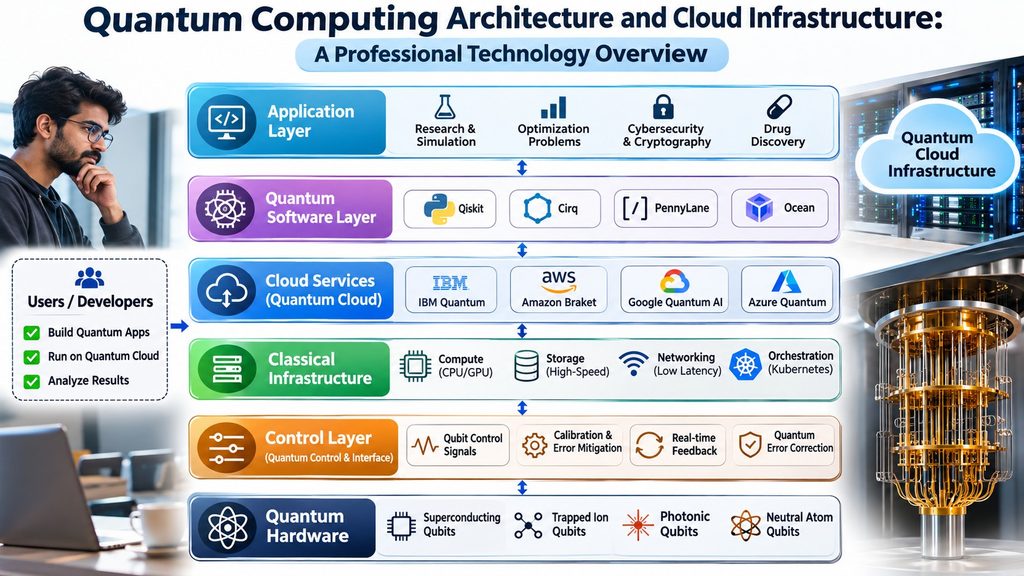
It focuses on complete system design rather than programming alone. Learners study applications, frameworks, compilers, control systems, quantum hardware, cloud infrastructure, and classical computing resources.
3.7.2 Major Architecture Components
1. Application Layer
Defines the business or research problem and prepares application logic.
2. Programming Framework Layer
Provides tools for representing quantum circuits and operations.
3. Compiler Layer
Transforms circuits into instructions suitable for the target system.
4. Control Layer
Supports the operation of physical quantum hardware.
5. Hardware Layer
Contains the physical quantum processor and associated equipment.
6. Cloud Infrastructure Layer
Provides remote access, resource management, and execution services where supported.
7. Classical Processing Layer
Handles data preparation, optimisation, application control, and result analysis.
8. Measurement Layer
Collects quantum measurement outcomes and returns classical information.
3.7.3 Step-by-Step Learning Process
- Understand application requirements.
- Identify required architecture components.
- Study quantum programming frameworks.
- Understand circuit representation.
- Learn compiler and transpiler operations.
- Study logical and physical qubits.
- Understand device connectivity.
- Explore quantum noise and error limitations.
- Study cloud execution.
- Understand classical processing.
- Prepare an architecture diagram.
- Document the complete workflow.
3.7.4 Practical Architecture Assignment
Design a basic quantum application architecture.
Include:
- Application requirements.
- Programming language.
- Quantum framework.
- Circuit design.
- Compilation process.
- Simulator or hardware.
- Execution management.
- Measurement handling.
- Result processing.
- Security considerations.
Explain how information travels between components and identify their dependencies.
3.7.5 Professional Applications
Architecture knowledge can support solution architects, system architects, cloud architects, engineering leads, and technical project managers.
3.7.6 Expected Learning Outcome
You should be able to explain the architecture of a quantum application and identify its major software, hardware, and infrastructure components.
3.8 hybrid quantum classical computing training
3.8.1 What Is Hybrid Quantum Classical Computing Training?
Hybrid quantum classical computing training teaches professionals how classical computers and quantum systems work together.
Classical computers can prepare data, update parameters, manage operations, and analyse results. Quantum systems perform selected quantum circuit operations.
Many experimental algorithms involve repeated interactions between these two computing environments.
3.8.2 Important Learning Topics
- Classical programming.
- Quantum circuit development.
- Parameterised circuits.
- Quantum measurement.
- Classical optimisation.
- Iterative algorithms.
- Hybrid architecture.
- Simulator execution.
- Cloud execution.
- Result processing.
- Error handling.
- Performance evaluation.
3.8.3 Step-by-Step Learning Process
Step 1: Study classical optimisation.
Understand objective functions and parameter updates.
Step 2: Learn parameterised circuits.
Understand how adjustable values influence quantum gate operations.
Step 3: Create a quantum circuit.
Build a circuit that uses adjustable parameters.
Step 4: Execute the experiment.
Run it with an appropriate simulator or supported quantum device.
Step 5: Retrieve measurement results.
Collect the circuit output for further processing.
Step 6: Calculate the objective value.
Use classical code to evaluate the measurements.
Step 7: Update parameters.
Apply a classical optimisation method to select new values.
Step 8: Repeat execution.
Run the circuit again with the updated parameters.
Step 9: Record the experiment.
Save parameter values, measurements, and objective changes.
Step 10: Compare the results.
Evaluate the experiment against a suitable classical baseline.
3.8.4 Important Algorithm Examples
Variational Quantum Eigensolver: A hybrid algorithm studied for estimating the energy of molecular systems.
Quantum Approximate Optimization Algorithm: A hybrid method studied for combinatorial optimisation problems.
These methods are important learning subjects. Their practical effectiveness depends on the problem, implementation, and available hardware.
3.8.5 Practical Assignment
Create a parameterised circuit and connect it to a classical optimisation routine.
Record circuit parameters, measurement results, objective values, and changes across multiple iterations.
3.8.6 Professional Applications
Hybrid computing knowledge can support algorithm engineers, researchers, data scientists, quantum developers, and cloud professionals.
3.8.7 Expected Learning Outcome
You should understand how quantum execution and classical processing interact within an iterative workflow.
3.9 quantum computing consulting services
3.9.1 What Are Quantum Computing Consulting Services?
Quantum computing consulting services help organisations understand the technology and evaluate possible technical applications.
Consulting may involve algorithm assessment, architecture planning, cloud strategy, training, technical feasibility, and proof-of-concept development.
A responsible engagement starts with a specific problem and realistic evaluation criteria.
3.9.2 Important Consulting Areas
- Quantum technology assessment.
- Business problem analysis.
- Algorithm suitability evaluation.
- Quantum cloud strategy.
- Application architecture.
- Hybrid system design.
- Programming framework evaluation.
- Technical training.
- Proof-of-concept development.
- Security considerations.
- Cost assessment.
- Project recommendations.
3.9.3 Step-by-Step Consulting Process
Step 1: Understand business requirements.
Identify the organisation’s objectives and existing technical environment.
Step 2: Define the problem.
Convert the business requirement into a specific technical question.
Step 3: Study classical solutions.
Evaluate existing approaches and their limitations.
Step 4: Assess quantum suitability.
Check whether a relevant quantum algorithm or research method exists.
Step 5: Identify technical resources.
Review software, cloud, hardware, data, and specialist requirements.
Step 6: Design the technical workflow.
Prepare the proposed architecture and execution process.
Step 7: Estimate project costs.
Include training, development, infrastructure, and testing expenses.
Step 8: Develop a proof of concept.
Create a limited experiment with clearly defined objectives.
Step 9: Evaluate the outcome.
Compare the results with a suitable classical baseline.
Step 10: Prepare recommendations.
Document findings, assumptions, limitations, risks, and possible next steps.
3.9.4 Possible Consulting Deliverables
Depending on the agreed scope, professional deliverables may include:
- Technical feasibility report.
- Architecture proposal.
- Algorithm evaluation.
- Staff training plan.
- Cloud workflow design.
- Prototype assessment.
- Cost analysis.
- Risk evaluation.
- Final recommendations.
3.9.5 Professional Applications
This subject can support technology consultants, enterprise architects, solution designers, research teams, and technical project leaders.
3.9.6 Expected Learning Outcome
You should understand how organisations can evaluate quantum computing opportunities through defined requirements and practical experiments.
3.10 quantum computing for IT managers
3.10.1 What Is Quantum Computing for IT Managers?
Quantum computing for IT managers focuses on planning, budgeting, team readiness, governance, and technical decision-making.
Managers do not need to perform every programming operation. However, they should understand the fundamentals and evaluate technical proposals effectively.
They should also recognise that quantum computers complement classical computing rather than replacing it for every task.
3.10.2 Important Management Topics
- Quantum computing fundamentals.
- Business use-case evaluation.
- Technology readiness.
- Employee skills assessment.
- Training requirements.
- Infrastructure planning.
- Cloud resource selection.
- Budget management.
- Security and governance.
- Technical risk assessment.
- Project milestones.
- Performance evaluation.
3.10.3 Step-by-Step Management Process
Step 1: Understand the technology.
Learn qubits, quantum gates, measurement, algorithms, and hardware limitations.
Step 2: Identify a business problem.
Select a problem that requires technical investigation.
Step 3: Review classical alternatives.
Understand how existing systems solve the problem.
Step 4: Identify required professionals.
Determine whether the project needs developers, cloud engineers, architects, or researchers.
Step 5: Prepare a training plan.
Select learning activities based on employee responsibilities.
Step 6: Review infrastructure requirements.
Evaluate cloud access, permissions, security, and execution resources.
Step 7: Prepare the budget.
Estimate learning, development, infrastructure, and experiment costs.
Step 8: Define project objectives.
Set deliverables, milestones, timelines, and success criteria.
Step 9: Conduct a limited pilot.
Test the proposed approach with controlled resources.
Step 10: Evaluate the results.
Compare the findings with the original objectives and suitable classical approaches.
3.10.4 Practical Management Example
An organisation wants to investigate a complex optimisation problem.
The IT manager asks the technical team to explain the existing approach. The team then studies whether a relevant quantum method exists and prepares a limited experiment.
The manager approves a defined project scope, budget, and timeline. The final report explains the results, costs, assumptions, and limitations.
3.10.5 Professional Applications
This knowledge can support IT managers, technology directors, enterprise architects, project managers, and digital transformation leaders.
3.10.6 Expected Learning Outcome
You should be able to evaluate quantum technology proposals, assess team readiness, and guide technical projects with clear objectives.
4. Four Practical Projects for Quantum Computing Training
Projects help learners turn theoretical knowledge into practical experience.
4.1 Project One: Superposition Experiment
Objective: Understand how a Hadamard gate changes a qubit’s state.
Steps:
- Prepare a development environment.
- Create a circuit with one qubit.
- Apply a Hadamard gate.
- Add measurement.
- Run the circuit in a simulator.
- Collect measurement results.
- Repeat the experiment.
- Study the result distribution.
- Explain the observations.
- Document the experiment.
Expected Learning: Understand superposition and probabilistic measurement.
4.2 Project Two: Entanglement Experiment
Objective: Study correlations between two entangled qubits.
Steps:
- Create a circuit with two qubits.
- Apply a Hadamard gate to the first qubit.
- Apply a controlled-NOT gate.
- Measure both qubits.
- Execute repeated measurements.
- Collect the results.
- Analyse the relationship between outcomes.
- Compare with an ideal simulation.
- Explain the correlations.
- Prepare a project report.
Expected Learning: Understand a basic Bell-state experiment.
4.3 Project Three: Cloud Quantum Execution
Objective: Understand remote quantum job management.
Steps:
- Prepare an approved cloud environment.
- Configure access permissions.
- Create a quantum circuit.
- Test it locally.
- Select a supported execution environment.
- Submit a task.
- Monitor its status.
- Retrieve the output.
- Record execution settings.
- Document the complete workflow.
Expected Learning: Understand cloud-based quantum execution.
4.4 Project Four: Hybrid Quantum-Classical Experiment
Objective: Understand how quantum circuits and classical programmes work together.
Steps:
- Choose an educational optimisation problem.
- Define an objective function.
- Create a parameterised circuit.
- Execute the circuit.
- Collect measurement results.
- Calculate the objective value.
- Update circuit parameters.
- Repeat the experiment.
- Record each iteration.
- Compare the result with a classical baseline.
Expected Learning: Understand iterative hybrid computing.
5. Evaluate Your Technical Skills
Completing lessons does not automatically demonstrate professional ability. You should assess whether you can perform practical tasks independently.
| Skill Area | What You Should Demonstrate |
|---|---|
| Quantum fundamentals | Explain qubits, superposition, entanglement, and measurement |
| Mathematics | Understand basic vectors, matrices, and probability |
| Programming | Create and modify quantum circuits |
| Simulation | Execute circuits and analyse measurement results |
| Cloud computing | Understand task submission and monitoring |
| Architecture | Explain major system components |
| Hybrid computing | Describe classical and quantum interaction |
| Project development | Complete a documented experiment |
| Technical evaluation | Identify limitations and assumptions |
| Communication | Explain technical findings clearly |
Review these areas regularly. Practise weak topics before moving into advanced subjects.
6. Develop a Professional Quantum Computing Portfolio
A portfolio helps employers and technical teams understand your practical abilities.
Follow these steps:
- Create a dedicated project repository.
- Organise experiments into individual folders.
- Add readable source code.
- Include installation instructions.
- Document dependencies.
- Add circuit diagrams where useful.
- Explain project objectives.
- Include sample outputs.
- Record the simulator or execution environment.
- Explain technical limitations.
- Document improvements.
- Maintain project documentation.
A strong portfolio should explain what you actually tested. Avoid presenting educational demonstrations as proof of commercial performance or production readiness.
7. Follow a 90-Day Quantum Computing Learning Roadmap
This roadmap divides your learning process into six stages. It assumes regular study and practical exercises.
7.1 Days 1–15: Learn Quantum Fundamentals
- Day 1: Introduction to quantum computing.
- Day 2: Classical bits and qubits.
- Day 3: Quantum states.
- Day 4: Superposition.
- Day 5: Entanglement.
- Day 6: Measurement.
- Day 7: Revision.
- Day 8: Vectors.
- Day 9: Matrix operations.
- Day 10: Probability.
- Day 11: Complex numbers.
- Day 12: Quantum gates.
- Day 13: Quantum circuits.
- Day 14: Circuit diagrams.
- Day 15: Fundamentals exercise.
7.2 Days 16–30: Learn Python and Qiskit
- Day 16: Install Python.
- Day 17: Prepare the development environment.
- Day 18: Learn Python variables.
- Day 19: Practise data structures.
- Day 20: Learn functions.
- Day 21: Install Qiskit.
- Day 22: Create your first circuit.
- Day 23: Practise the Hadamard gate.
- Day 24: Learn the Pauli-X gate.
- Day 25: Study the controlled-NOT gate.
- Day 26: Add measurements.
- Day 27: Run a simulator.
- Day 28: Analyse measurement results.
- Day 29: Create a Bell-state circuit.
- Day 30: Complete a programming exercise.
7.3 Days 31–45: Practise Programming
- Day 31: Revise quantum programming.
- Day 32: Learn quantum registers.
- Day 33: Study circuit depth.
- Day 34: Practise gate combinations.
- Day 35: Explore visualisation.
- Day 36: Understand transpilation.
- Day 37: Study hardware connectivity.
- Day 38: Learn backend selection.
- Day 39: Compare simulation configurations.
- Day 40: Practise testing.
- Day 41: Learn debugging.
- Day 42: Study quantum algorithms.
- Day 43: Explore Grover’s algorithm.
- Day 44: Review exercises.
- Day 45: Complete a programming project.
7.4 Days 46–60: Explore Quantum Cloud Computing
- Day 46: Learn quantum cloud computing.
- Day 47: Understand remote execution.
- Day 48: Study cloud quantum services.
- Day 49: Learn access management.
- Day 50: Explore quantum simulators.
- Day 51: Understand notebook environments.
- Day 52: Prepare a cloud-ready circuit.
- Day 53: Run a simulation.
- Day 54: Learn task submission.
- Day 55: Study job monitoring.
- Day 56: Retrieve results.
- Day 57: Explore another programming framework.
- Day 58: Study hybrid execution.
- Day 59: Compare cloud workflows.
- Day 60: Complete a cloud project.
7.5 Days 61–75: Study Architecture and Hybrid Computing
- Day 61: Learn quantum architecture.
- Day 62: Understand application layers.
- Day 63: Explore programming frameworks.
- Day 64: Study compilers.
- Day 65: Learn physical qubit mapping.
- Day 66: Understand device connectivity.
- Day 67: Study quantum noise.
- Day 68: Learn error correction.
- Day 69: Understand hybrid systems.
- Day 70: Study parameterised circuits.
- Day 71: Practise classical optimisation.
- Day 72: Explore VQE.
- Day 73: Explore QAOA.
- Day 74: Create an architecture diagram.
- Day 75: Complete an architecture assignment.
7.6 Days 76–90: Projects and Career Preparation
- Day 76: Select your final project.
- Day 77: Define project objectives.
- Day 78: Design the circuit.
- Day 79: Run simulator tests.
- Day 80: Collect measurements.
- Day 81: Analyse limitations.
- Day 82: Compare classical alternatives.
- Day 83: Prepare documentation.
- Day 84: Organise source code.
- Day 85: Review certification options.
- Day 86: Practise interview questions.
- Day 87: Prepare a project presentation.
- Day 88: Evaluate your technical skills.
- Day 89: Identify advanced topics.
- Day 90: Prepare your next learning plan.
Expected Outcome: This roadmap can help you develop foundational knowledge, programming experience, cloud execution skills, and an initial project portfolio. Advanced expertise requires further study and practical experience.
8. Career Opportunities in Quantum Computing
Different professional roles require different skill combinations.
8.1 Quantum Software Developer
Focuses on programming frameworks, circuit development, algorithm implementation, testing, and simulation.
8.2 Quantum Cloud Engineer
Works with cloud infrastructure, authentication, permissions, remote execution, and job management.
8.3 Quantum Solutions Architect
Focuses on application design, system components, hardware restrictions, and technical integration.
8.4 Quantum Research Engineer
Works with mathematical models, algorithms, simulations, and research experiments.
8.5 Quantum Technology Consultant
Supports technical assessment, architecture planning, training, and proof-of-concept development.
8.6 Quantum Technology Manager
Focuses on training, budgeting, project governance, technology planning, and team readiness.
Job responsibilities vary between organisations. Review individual role requirements before choosing your professional direction.
9. Common Mistakes to Avoid
- Starting advanced algorithms before understanding the basics.
- Ignoring mathematics and probability.
- Copying code without understanding its purpose.
- Learning several frameworks simultaneously.
- Assuming simulator results always match hardware.
- Ignoring connectivity and hardware noise.
- Overlooking cloud costs and permissions.
- Treating every certificate as an accredited qualification.
- Assuming quantum computers replace classical systems.
- Claiming performance benefits without sufficient testing.
A gradual approach helps you build stronger technical knowledge and avoid confusion.
10. Frequently Asked Questions
10.1 What is quantum cloud computing training?
Quantum cloud computing training teaches professionals how to access supported quantum simulators and hardware remotely. It includes circuit development, authentication, task submission, monitoring, and result analysis. It also introduces cloud permissions, resource management, and execution limitations.
10.2 What does a quantum computing certification course teach?
A course may cover quantum mathematics, qubits, gates, circuits, algorithms, programming frameworks, simulations, and practical assessments. Advanced programmes may also include cloud execution, architecture, hardware, and hybrid computing.
10.3 What is QuantumOps certification?
QuantumOps certification is a professional learning topic associated with quantum engineering, operations, architecture, and management. Learners should evaluate the specific programme, practical assessments, issuing organisation, and independent recognition claims.
10.4 Why should developers learn Qiskit?
Qiskit provides Python-based tools for creating and analysing quantum circuits. Developers can practise gates, measurement, simulation, and transpilation. These activities provide practical experience with quantum programming.
10.5 What does AWS Braket training cover?
AWS Braket training introduces quantum circuit development, simulator execution, remote job submission, supported hardware access, and results retrieval. It can also cover hybrid jobs, access management, and cloud resource costs.
10.6 Is quantum computing useful for software engineers?
It gives software engineers an opportunity to explore quantum programming and experimental applications. Their skills in Python, debugging, testing, and documentation remain useful. They must also understand quantum states, measurements, circuits, and hardware limitations.
10.7 What is included in a quantum computing architecture course?
It covers application design, programming frameworks, compilers, qubit mapping, hardware connectivity, cloud infrastructure, and results processing. Learners understand how classical and quantum components interact.
10.8 Why is hybrid quantum classical computing important?
Hybrid computing combines classical processing with quantum circuit execution. Classical programs prepare data, update parameters, and analyse results. Quantum systems perform circuit operations within the same workflow.
10.9 What do quantum computing consulting services provide?
They may include technology assessment, algorithm evaluation, architecture planning, cloud strategy, employee training, and prototype development. A responsible engagement defines objectives and compares experimental results with suitable classical methods.
10.10 How can IT managers prepare their teams?
IT managers can start with fundamental training and role-based learning. They should evaluate employee skills, identify relevant projects, estimate costs, review security, and define clear criteria for assessing experiments.
11. Final Thoughts
Quantum computing combines mathematics, programming, algorithms, cloud infrastructure, and system architecture. Professionals can build these abilities through structured learning and practical implementation.
The ten topics in this guide provide different learning paths for software engineers, cloud professionals, architects, researchers, and IT managers.
Start with fundamental concepts and select training based on your professional goals. Develop simple circuits, run simulations, explore cloud execution, and document your projects.
Most importantly, understand the limitations of current technology. Compare your experiments with classical approaches and explain what your results actually demonstrate.
Consistent practice and careful technical evaluation can help you develop practical quantum computing knowledge and prepare for further professional learning.
Leave a Reply